
TW: Purging
Part 1: Emily VS Food
For those who know me, it is no secret that I love eating and exploring new food places. I even have an Instagram page dedicated to reviewing food (@avocabroes!). Some of my all-time favourites include acai, mentaiko and mochi. Yet, the very same indulgences that fill me with joy often leave behind a familiar undertow of shame once the initial pleasure subsides.
The first time I purged was in Secondary 4, a day before my PE lesson where I would be taking my height and weight. I remember not being able to vomit on the first try. “This is harder than I thought” flashed across my mind as I dug deeper into my gag reflex, hoping that remnants of food would come out this time instead of water.
It brings me some comfort knowing that my eating habits are far from binging (according to the DSM-5 criteria[1]), and I do not have an eating disorder. That being said, perhaps the combination of my love for sweet food and my genetic makeup means that I can easily gain 0.5kg in a day, and yet take a disproportionate amount of time, effort and self-control to lose it.
The easiest and most obvious method is to cut down on my nemesis — processed food. But alas, food is also a love language, and how can I reject the love from my family and friends? It’s my dad cooking my favourite meals when I come home, or my mum buying a red bean pastry on the way back home because she thought of me, or my friends sharing food because I can’t finish it myself. Behind every dessert session after a meal is “Let’s go to another place and talk, I want to spend more time with you”. Under the biological components that make up the food itself are layers of “I saw this and thought you might like it”, “I’m not very hungry but I’ll eat it with you”, and my favourite, “I know you don’t like cheese, I’m willing to share the cheeseless bagel with you.”
Part 2: The start of my running journey
Running did not enter my life as a solution, but as something far more accidental. I only started running consistently in Semester 1 of Year 1, after my friend impulsively signed us up for a 10km run in October 2024, and we realised we had to train to prevent ourselves from fainting during the run. Even then, I would only make it a point to run once a week around UTown (it started with 2 rounds, then 3, then one round around NUS…) It was not until summer break that I found myself willingly running 25km a week.
There is often an awkward, uneasy time lag between beginning to run and genuinely deriving pleasure from it. Mine lasted two full semesters. That liminal period was excruciating – stitches, leg cramps, the kind of fatigue that drains the rest of your day, making me contemplate why I chose to run 7km around NUS on a Sunday night instead of sleeping blissfully in my bed (and begging my friend to let me take D2 back, whose refusal meant I had to continue running up the treacherous NUS hills). Yet, somewhere in that slog, something changed.
Part 3: Run to eat
Slowly, running rewired the way I thought about food. Instead of chastising myself for eating something I originally didn’t plan for, I could ‘neutralise’ the overall calories consumed by running afterwards. Or if I knew I was going to eat something unhealthy later in the day, I would run before that so I could savour my mala without the usual cloud of guilt later on. My physique gradually improved after I started running more consistently, and I became more confident of the way I looked. (I can now wear sleeveless tops and short skirts without feeling ashamed of my fats!) Perhaps most importantly, running became a significantly easier (and healthier) alternative to sticking a toothbrush down my throat.
Even then, the relationship between running and food is never purely restorative. Once, when I was doing intervals and felt like vomiting, I felt a disorienting sense of…happiness? Relief? Now I can vomit out my dinner, while getting fitter from running, that’s a double-win. Or there would be times where I had no appetite after my long runs, and I would just take it as a sign to skip dinner. Further complicating matters was how the relationship between running and food was bidirectional. Sometimes, I would run after eating. Other times, when I desperately needed motivation to run 20km, I would eat something mildly unhealthy before that, telling myself, “Now I have no choice but to run.”
Part 4: Conclusion
While food is and has been central to why I run, I discovered little joys along my running journey, which showed me that there is more to running than a mere form of “compensation”. Running has been a great coping mechanism when I’m crashing out in university. With each breath and each step you take, running grounds you into the present, yet paradoxically offers you an escape from reality. In a world that moves too fast, running allows you to slow down and be in the moment.
Running gave me the space to push my limits and strengthen my mental resilience. It taught me to find pride in progress rather than obsessing over specific outcomes or ranking. There is no “perfect” timing or distance, no numerical 90RP or FCH. No rat race, with my only competitor being my past self. It feels liberating to focus on the process, and fully immerse myself in the scenic views and conversations along the way. Each new distance and personal record is a gentle reminder that growth is continuous and that my potential is not constrained by a single numerical measure.
In fact, for all the post-run endorphins and reasons mentioned above, even on days where I’m eating properly, I still choose to run, driven by passion instead of guilt. I’ve also been exercising self-control to refrain from purging, and changing my view of food to ‘fuel’ so I can run longer and become stronger. I am hopeful that there will come a time, where I no longer weigh myself regularly, and that running to punish my body will be completely out of the question. I will simply run because I enjoy it.
Lastly, while running can be a solitary sport, I am never truly alone. I am incredibly blessed to have met so many capable runners in university, and friends who dislike running yet still choose to accompany me. Thank you for adjusting your pace to match mine, even when it’s slower than yours. Thank you for exploring new routes, for indulging in celebratory meals afterwards, for keeping me company during late-night runs around UTown, SP, NUS and Ulu Pandan where we talked about anything and everything. Thank you for making the miles feel lighter, you know who you are <3 :”)
About the Author
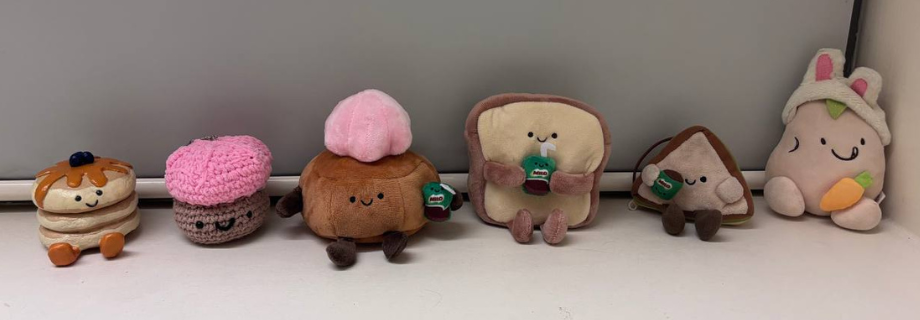
Emily is a Year 2 Psychology student who enthusiastically collects food plushies and art prints. As a self-proclaimed food connoisseur, she has a soft spot for neighbourhood bakeries and cafes and hopes that more people can patronise them.
[1]An episode of binge eating is characterized by both of the following: 1. Eating, in a discrete period of time (e.g., within any 2-hour period), an amount of food that is definitely larger than what most individuals would eat in a similar period of time under similar circumstances. 2. A sense of lack of control over eating during the episode (e.g., a feeling that one cannot stop eating or control what or how much one is eating).